A near-death experience (NDE) is the memory of peace, light or encounters with the dead that some people report after coming close to dying. That these experiences happen is documented; what they are is not. Rebeca Falcó tells hers on No me hables de tu libro, and what holds up best under scrutiny is not her description of the afterlife but her critique of the spirituality business.
If you came here looking for someone to confirm that heaven exists, this article won't do it. What you get is her testimony, in full and taken seriously, kept apart from what can be verified. And you get the part of what she says that stands without believing in anything: her rejection of “set-dressing spirituality”.
What is a near-death experience?
It is an episode of consciousness that someone remembers after being in mortal danger, with recurring features: peace, light, a sense of leaving the body, meeting dead relatives or a review of one's life. It is measured with the Greyson scale and, according to a study published in PeerJ in 2019, one in ten people report one.
That study came from the team of Daniel Kondziella, a neurologist at the University of Copenhagen. They surveyed 1,034 people in 35 countries and checked every account against the scale, which requires at least 7 points to count as an NDE. 106 participants, or 10%, met the threshold.
Among people who survive cardiac arrest, the share goes up. Cardiologist Pim van Lommel followed 344 resuscitated patients in ten Dutch hospitals and published the results in The Lancet in 2001: 62 of them, or 18%, reported an NDE. A scoping review of prospective studies published up to July 2023 found figures ranging from 6.3% to 39.3%, depending on the study.
A phenomenological study of cardiac arrest survivors, available on PubMed Central, lists the most common elements: leaving the body, pleasant emotions, a tunnel or a light, deceased relatives and a review of one's own life.
It's common. Being common doesn't explain what it is.
Rebeca Falcó's account: a knee, a cardiac arrest and “home”
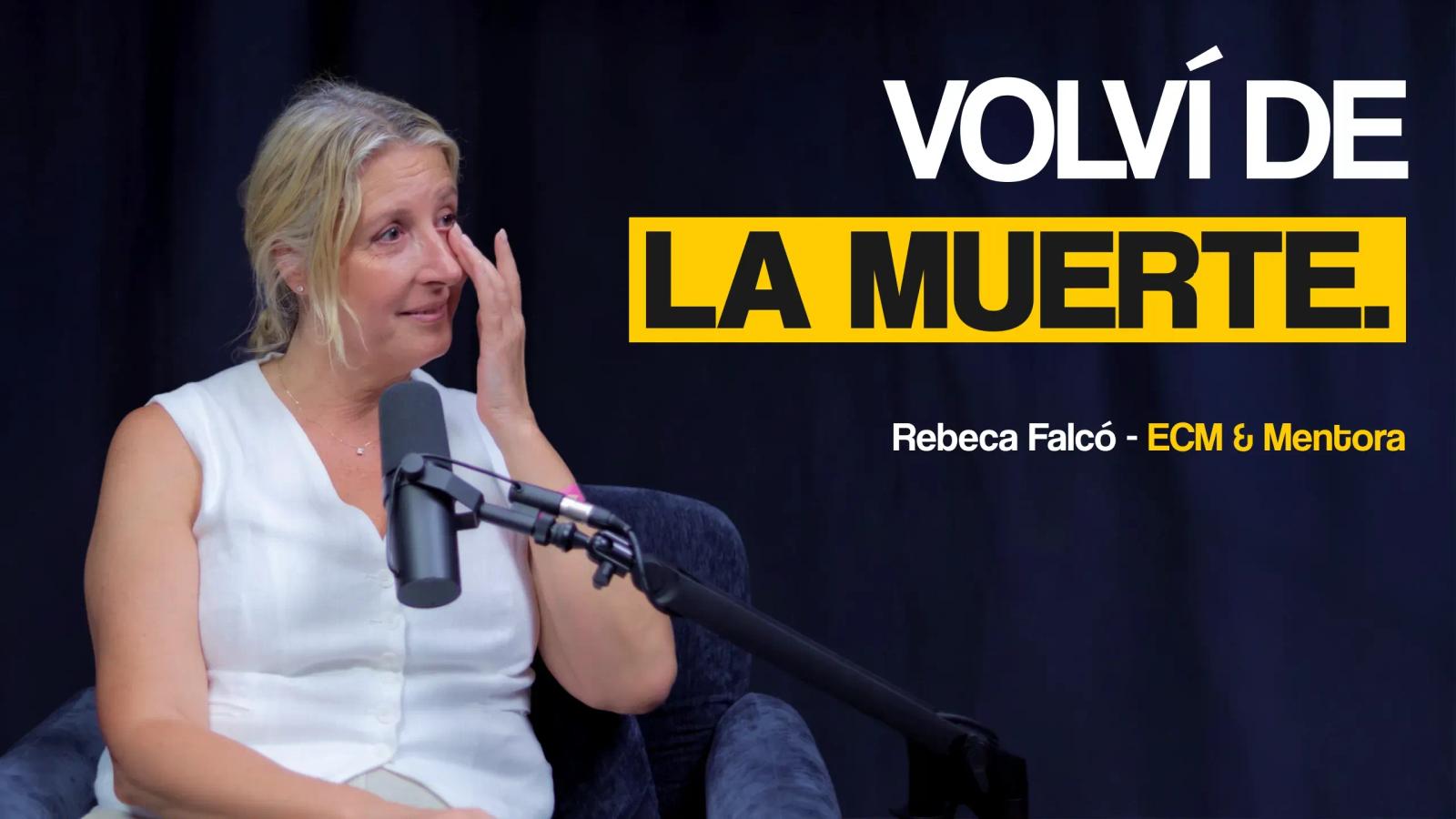
By her account, Rebeca Falcó went into cardiopulmonary arrest at the end of knee arthroscopy. She says her heart was restarted, that her lungs took up to 40 minutes to work again and that she then spent five days in a coma. From that time she says she remembers a place she calls “home”.
The operation, she explains, was as simple as they come: she had had a prosthesis for a year, was bleeding for no known reason and her surgeon wanted to check it. Once the procedure was over, she was extubated, given the drug that reverses anaesthesia and went into arrest. The last thing she remembers is the anaesthetist putting the mask on her.
One nuance in her own account: the episode talks about 40 minutes “clinically dead”, but she describes her heart coming back sooner and her lung function being what took longer. She mentions a document in which the anaesthetist wrote down what happened; we haven't seen it. She says she was left with no neurological or physical after-effects, although shortly after leaving hospital she had a pulmonary embolism.
She doesn't describe seeing herself from outside her body in the operating theatre. She describes “home” as the place “where we come from and where we go back to”, her father sitting there waiting for her, and a figure she identifies as Jesus, “huge”, with “a striking light”. She herself links that image to her religious upbringing. The message she says she received: “Forgiveness and love”.
What does dying feel like, according to someone who says she came back?
Rebeca Falcó sums it up like this: “dying is easy”. She describes a moment in which, as she tells it, the mind switches off and only “peace and calm” remain. It is her experience, not a medical description of death, and it fits the feature the journal Missouri Medicine identifies as typical of these accounts: detachment and peace.
For her, the hard part is on the other side: “being born is hard”. She says it without drama: “It's closing your eyes. And that's it”. She adds that she didn't know she was dead and that fear, as she sees it, belongs to the mind, which knows it will come to an end.
Van Lommel's study offers an awkward fact for quick explanations: whether a patient had the experience did not depend on how long the arrest lasted, on medication, or on how afraid of dying they were beforehand. Fearing death a lot or a little did not predict who would come back with a story.
What tends to change is life afterwards. Charlotte Martial, a neuroscientist at the University of Liège, told The Washington Post that for most people who have one it is a life-transforming experience. Falcó puts it in the first person: before, she lived “from struggle, from stress” and couldn't sleep because her mind kept waking her up. Now she says she sleeps well.
The experience proves nothing about death. It paints a fairly precise picture of the life that came before.
Are near-death experiences real? What the science says
They are real as experiences: studies record them and validated scales measure them. What remains open is where they come from. The authors of the AWARE-II study conclude that research has neither proved nor disproved the reality or the meaning of what patients report.
AWARE-II was led by Sam Parnia of NYU Langone and published in Resuscitation in 2023. It followed 567 cardiac arrest patients in hospitals in the US and the UK. Fewer than 10% made it to discharge and, of those survivors, four in ten recalled some degree of awareness during resuscitation.
Jimo Borjigin's team at the University of Michigan reported in PNAS in 2023 that two of four dying patients showed a spike in gamma activity when ventilation was withdrawn. The authors themselves write that they cannot rule out a pathological process unrelated to consciousness.
In 2025, the Coma Science Group in Liège proposed the NEPTUNE model in Nature Reviews Neurology: a cascade of psychological and neurophysiological processes triggered by lack of oxygen, low blood pressure and chemical imbalances in the brain. Its authors present it as theoretical, and in February 2026 Bruce Greyson, who gives his name to the scale, was disputing key parts of the model in The Washington Post.
In the episode, Álvaro Barrera put to Rebeca the neuroscientist's reading that reduces it all to a discharge in the brain. Her answer: “that's fine by me”. Science hasn't closed the case. A blog isn't going to close it either.
“Set-dressing spirituality”: a psychic against psychics
What holds up best in Rebeca Falcó's message requires no faith: her critique of her own trade. She distances herself from incense and from the TikTok spirituality boom, argues that perceiving what she perceives is not an exclusive gift, and admits she called herself a psychic because Instagram demanded a label.
Asked about TikTok mediums, she is fine with whatever people do “as long as it's ethical, moral and legal”, but she isn't buying the props: “I'm not going to be hugging trees with incense. I don't know if that's being spiritual”.
On the label: “I had to give myself a name for Instagram. Sensitive, psychic. And that was the easy option”. Barrera laughs; she turns it around: “The world asks you to classify yourself”. Are there fake psychics? One word: “I suppose”.
Her hardest punch is aimed at exclusivity: “we're all the same, we can all do it, it's not an exclusive gift of a few”. And she points at those who want it to be “their own property”. She isn't selling access; she's handing it out.
The trade has customers. According to Pew Research Center, 30% of Americans consult astrology, tarot cards or a fortune teller at least once a year, although most say they do it for fun. And the wellness economy in the broad sense was worth $6.8 trillion in 2024, according to the Global Wellness Institute. With that market in front of you, the label is not a detail. It is the product.
Can a session with a psychic replace a psychologist?
No. And Rebeca Falcó herself doesn't frame it that way: when Álvaro Barrera asked where she would send someone with serious trauma, she replied that in her sessions she doesn't diagnose or give opinions. What she describes is a spiritual practice. It is not healthcare and it does not take the place of any treatment.
Her exact answer: “I don't diagnose, I don't give opinions”. She says she simply tells the person “what I see”, that her sessions last 50 minutes and that some people come back. That is her way of describing what she does, not therapy.
Here we take a clear position. What you believe about the afterlife is your business. Trauma or grief that won't let you live is not a matter of belief: it is a health problem, and it is treated by healthcare professionals, starting with your GP and moving on to a clinical psychologist or a psychiatrist. No spiritual practice replaces that treatment or serves as a complement to it.
In the episode, Rebeca talks about signs and dreams involving people who are gone; that is how she lives with loss. If yours weighs more than you can carry, the door to knock on is a clinic's, not a session's.
Frequently asked questions
How many people have had a near-death experience?
Around 10% of the general population, according to Daniel Kondziella's study published in PeerJ in 2019. Among cardiac arrest survivors, Pim van Lommel's study in The Lancet recorded 18%.
Do near-death experiences prove there is life after death?
No. Van Lommel argues that consciousness can exist independently of the body; Charlotte Martial's team explains NDEs through brain processes. The authors of AWARE-II conclude that no study has proved or disproved their meaning.
What is the difference between an NDE and a hallucination?
The AWARE-II authors argue that these experiences are distinct from hallucinations, delusions or dreams. Kondziella found that REM sleep intruding into wakefulness was more common among people who report them, 47% compared with 14% of those who had never had one, and he warns that association is not causation. Falcó says you can tell the difference because “you feel it”.
Who is Rebeca Falcó?
In the episode she describes herself as someone who helps people remember who they are, and explains that on Instagram she presents herself as a sensitive and psychic. She says she had a near-death experience after a cardiopulmonary arrest during knee arthroscopy.
We're not going to tell you what to believe. We're suggesting something harder: listening to someone tell you what she lived through without asking you to buy it. The full conversation with Rebeca Falcó is on YouTube (in Spanish). And if you want to know why we prefer the uncomfortable question to the shop-window speech, start with our manifesto or with the questions that ruin a conversation.