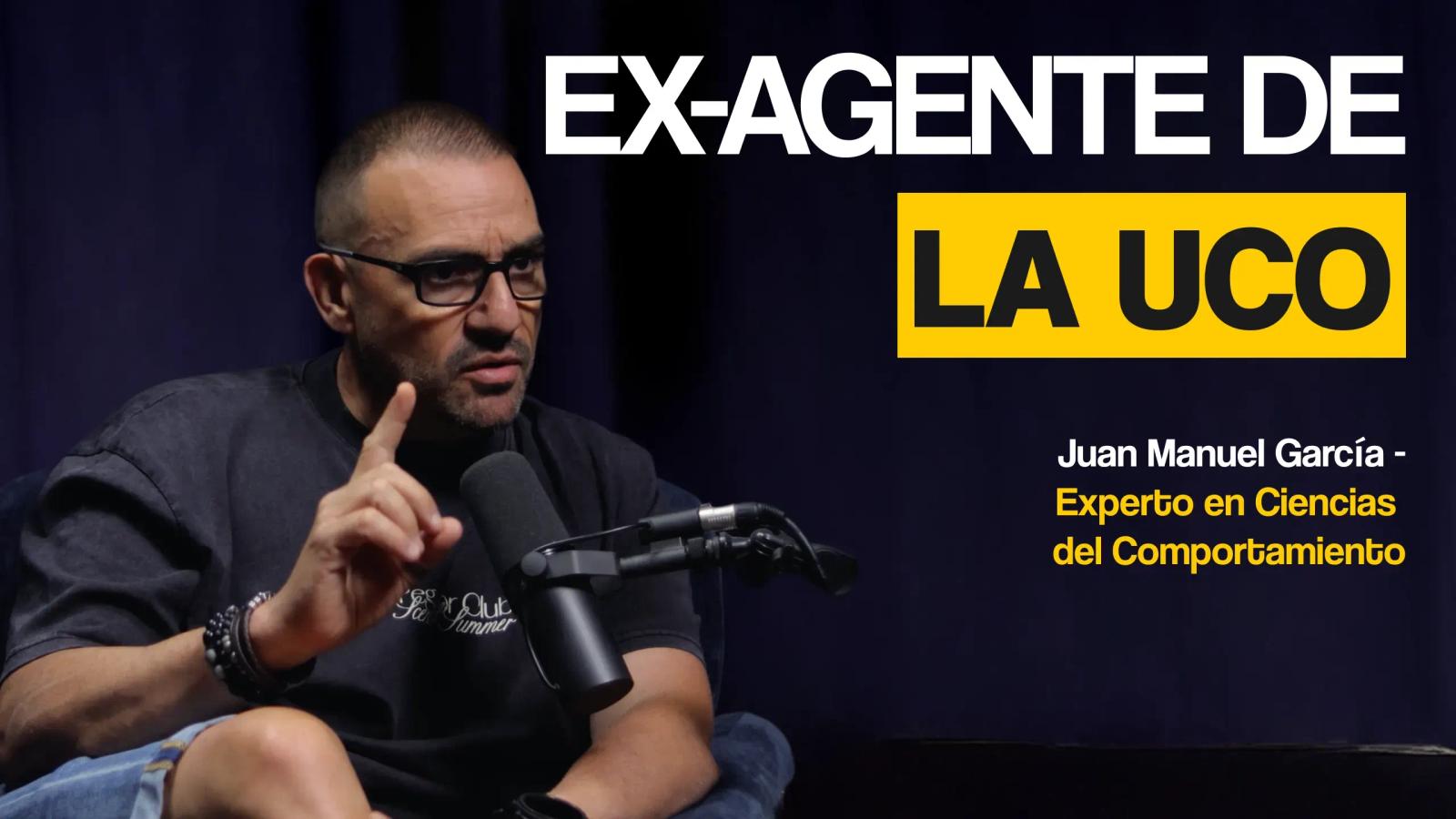
If you came here to learn how to catch liars by the way they scratch their nose, this isn't for you. Juanma García "Pincho", a former member of the UCO and a kidnapping and crisis negotiator, puts it bluntly in episode #37: lie detection doesn't exist.
What does exist is less marketable and more useful. Knowing how someone behaves when nothing is going on, and noticing the exact moment they stop behaving that way. That's the craft. The rest is social media content.
Who is Juanma García "Pincho"?
Juan Manuel García, known as "Pincho", was born in Cuenca, is a Guardia Civil officer on leave of absence and served in the Central Operative Unit (UCO), the force's elite investigation unit. His publisher, Planeta, credits him with almost six million followers, and he wrote the book Ciencias del comportamiento (Behavioural Sciences), published by Temas de Hoy in 2025.
In the episode he says he has spent almost ten years in the mental health group of the Spanish Society of Emergency Medicine and that he trained with the FBI. When Álvaro asks him to define himself without titles, he answers "an eternal student". As an analyst he picks a different word, "forward-looking", and lives it as a curse: he is always working out what could go wrong.
The first thing he takes apart is the movie interrogation room: desk lamp, sweat, not even a glass of water, good cop and bad cop. Pincho says that was done many years ago and that today it backfires. He wants people to talk, not to be afraid: a coffee, a cigarette and a chat almost like two mates. On a much smaller scale, it's what we try to do every week with a podcast without a script.
Research is heading the same way. In 2021 the Méndez Principles were published, proposing to replace coercive interrogation with rapport-based interviews, according to Northumbria University, one of the institutions behind them. Just Security reports they have already been translated into 24 languages. Fear doesn't open people up. It shuts them down.
Can you detect a lie through body language?
Not reliably. Pincho sums it up like this: no gesture or machine can tell you something is 100% a lie. Science backs him. The meta-analysis by Charles Bond and Bella DePaulo (2006), which pooled 206 studies, puts average accuracy at telling truth from lies barely above a coin toss.
The exact figure is 54% accuracy. And professionals who assess credibility for a living do no better than laypeople, according to the same paper. A second meta-analysis, by Maria Hartwig and Bond (2011), explains why: it's not that we look at the wrong cues, it's that the behaviour of liars and truth-tellers barely differs.
On the polygraph, Pincho is even more categorical. It measures physiological changes that can come from nerves or from the truth itself. In Spain it is not valid evidence in court, according to case law from the Constitutional Court and the Supreme Court.
That didn't stop him from finding a hidden gun thanks to a gesture. The story, as he tells it, is a lesson in caution. In the middle of a kidnapping negotiation, he asked the victim's relative whether he had ever thought of getting a hunting licence. "Guns scare me a lot," he replied, with a very specific reaction. Since Pincho doesn't trust isolated gestures, he gave it 50% credibility, waited two or three hours and asked again in different words. Same reaction, up to three times. They searched the room and found the gun.
A gesture is a question, not an answer.
"Gesture horoscope": why you read changes, not gestures
We call it a "gesture horoscope" when every gesture is treated as having a fixed meaning: crossed arms means rejection, touching your nose means lying. Pincho works the other way round. First he figures out how someone behaves when calm, what he calls their homeostatic window, and only then reads what falls outside it.
That window is each person's normal: how much they move, how they gesture, how they answer when nothing is at stake. Draw it as two lines and what matters are the spikes above or below. In the rapid-fire round he is asked whether crossed arms mean anything. Answer: "Myth".
That's why analysts who dissect every public appearance of the King or the Prime Minister grate on him. If nobody steps outside their window, there's nothing to report, and forcing a reading is manufacturing content. The gesture horoscope shares the essential trait of the other kind: it is always right about something.
And even reading well, you get it wrong. Pincho recalls how he and a colleague took a statement from a detainee's partner: a strikingly beautiful woman, polite, visibly upset. They believed every word. She knew everything. Appearance bias got the better of them.
For first impressions, his recipe fits in one line: eye contact, raise your eyebrows, smile and say hello. That eyebrow gesture has a name, the eyebrow flash, and the ethologist Irenäus Eibl-Eibesfeldt documented it as a greeting in cultures far apart from each other. In a job interview, his advice goes against the manuals: don't rehearse your chin or your hands. If you put on an act, the other person picks up the inconsistency.
How do you recognise a psychopath or a narcissist?
Not at first glance. Many psychopaths live integrated lives without harming anyone, and Pincho gives the example of neuroscientist James Fallon, who discovered his own psychopathic brain pattern while studying scans of murderers. With narcissists his alarm goes off sooner: when someone seems perfect from day one, be wary.
Fallon told his story to Smithsonian magazine: in 2005, reviewing PET scans at the University of California, Irvine, he came across one with low activity in areas linked to empathy and self-control. It was his own. He had never killed anyone.
Pincho insists that psychopaths do feel emotions, just not empathic ones: they are happy about their own good fortune, not yours. And he distrusts physical cues. A study published in the Journal of Research in Personality, based on interviews with 507 inmates in New Mexico, found that those who scored high on antisocial traits moved their heads less. Labelling someone on that basis, he says, would be reckless.
The episode mentions a figure of 15% psychopaths at the top of companies. The most cited study gives a lower figure, though just as uncomfortable: Paul Babiak, Craig Neumann and Robert Hare assessed 203 professionals selected for management development programmes, and 3.9% reached the psychopathy threshold, about four times the rate in the general population, according to Neumann.
Pincho fears the narcissist more than the integrated psychopath. His advice: "run". We all have a social self with edges people like more or less; whoever has none is putting on a show for you.
How can you tell if you're being followed, and how do criminals choose victims?
Someone walking behind you proves nothing. To find out, you have to provoke it: Pincho advises speeding up and, if the suspicion remains, making an illogical change of direction, crossing the street and crossing back. If the other person copies that zigzag, it's no longer a coincidence.
Someone hurrying because they forgot their keys doesn't repeat an absurd route. That's the filter. And only when the other person repeats it is it time to run.
On how victims are chosen, he says offenders who approach children have explained that they look at the parents, not the child: the one staring at their phone in the park makes it easy. With adults it's similar. Distraction, hesitation, eyes anywhere. His countermeasure is to walk with energy, chin up, and briefly meet the eyes of whoever approaches. An alert person means trouble, and criminals don't want trouble.
Research points the same way. In 1981, Betty Grayson and Morris Stein filmed more than 60 pedestrians in one of New York's highest-assault areas and asked inmates convicted of attacking strangers to rate whom they would target. According to them, what mattered most was how people moved: stride, coordination, energy when walking.
What should you do if you think someone is considering suicide?
Ask, directly and without fear. The review by Tiziana Dazzi and her team (2014) found no study in which asking about suicide increased suicidal ideation. Then stay close, don't judge and seek professional help: in Spain, the 024 line answers 24 hours a day, every day.
It is the area Pincho ranks above kidnappings. In his experience, interventions with people who want to end their lives are the hardest, and his goal is not to persuade but to postpone: give the person back a sense of control and buy time to talk. An "I'm here" works better than a sermon about how beautiful life is. He leaves emergency teams a warning: if the decision to step back isn't the person's own, it doesn't hold.
For non-professionals, the advice is to ask openly. A meta-analysis by Blades and colleagues (2018) concluded that talking about suicide with study participants did not increase risk and was associated with a small reduction in ideation.
There is one sign that gets misread: a sudden improvement after a very bad patch, especially when it comes with closure behaviours, like giving away treasured belongings or rehoming a pet. The Canary Islands Government's prevention guide lists that marked, unexplained improvement as a warning sign.
According to Spain's National Statistics Institute (INE), 3,953 people died by suicide in Spain in 2024, and provisional data for 2025 put the figure at 3,808. To families who didn't see it coming, Pincho says that nobody can detect what nobody has taught them to detect.
If you're going through a hard time or you're worried about someone, call 024 in Spain. It's free. If there is immediate danger, call 112.
Frequently asked questions
Who is Juanma García "Pincho"?
He is on leave from the Guardia Civil, served in the UCO and negotiates critical incidents. He shares content on non-verbal behaviour as @cienciasdelcomportamiento and is the author of Ciencias del comportamiento (Temas de Hoy, 2025).
Is the polygraph admissible as evidence in Spain?
No. Spanish courts do not accept its results as incriminating evidence. Pincho doesn't trust it either: it records nerves, not lies.
Do crossed arms mean rejection?
For Pincho it's a myth. A gesture only says something when it breaks that person's usual way of behaving.
What is the homeostatic window?
It is Pincho's term for someone's normal behaviour when nothing is at stake. What matters is not the gesture itself, but what falls outside that pattern.
Can asking someone if they are thinking about suicide make things worse?
No. The reviews by Dazzi (2014) and Blades (2018) did not find that asking increased risk. If you're worried about someone, ask, and in Spain call 024.
What doesn't fit here, like getting information out of someone without asking a single question (hint: make a mistake on purpose and let them correct you) or who Pincho would like to see sitting in this studio, is in the full conversation. Listen to episode #37 with Juanma García "Pincho". And if you're interested in the other side of the table, the one asking the questions, read the questions that ruin any interesting conversation.