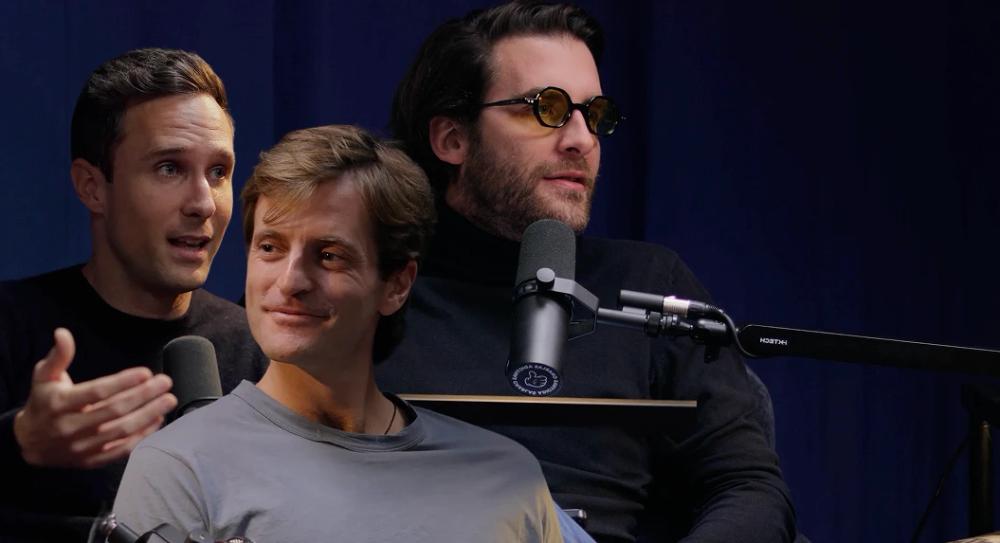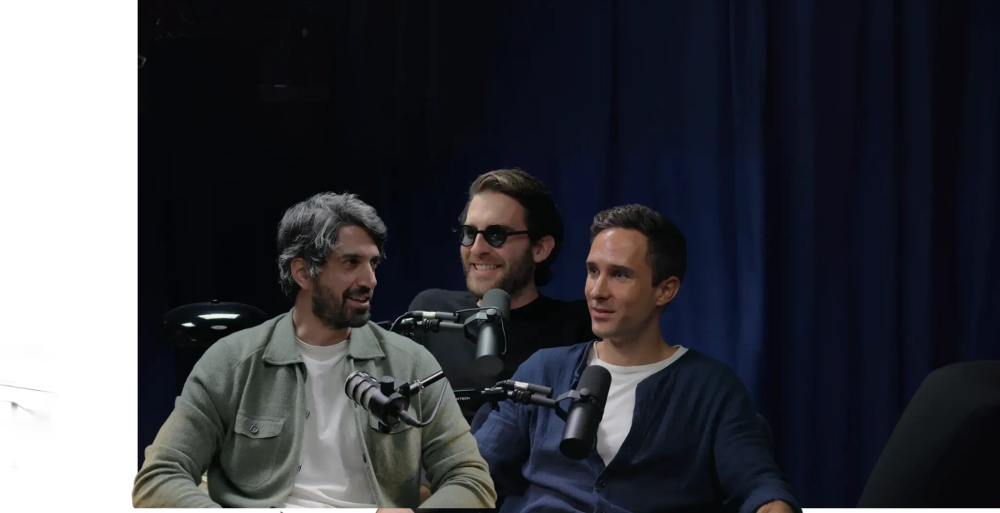
No me hables de tu libro ("Don't tell me about your book") is a Spanish-language interview podcast hosted by Álvaro Barrera, where the guest's script gets taken away. No rehearsed speech, no promotion: the talk is about what happens once the cameras are off. A new episode comes out every week, in audio and video.
If what you're after is hearing someone recite the three big ideas of their latest book, hundreds of shows will serve that up. This isn't one of them.
What is No me hables de tu libro?
NMHDTL is a podcast of conversations with people who are moving the world: founders, investors, health specialists, and artists. It's recorded mostly in a studio in Madrid, published in full on YouTube and Spotify, and built on one non-negotiable rule: the guest isn't here to promote anything.
The podcast's website sums it up in four lines that work as a filter. Everyone tells the same story. The interesting part never makes the headline. Here, the script comes off. And if you're here to promote yourself, you've come to the wrong place. What does make it into the conversation, according to that same statement, are obsessions, doubts, failures, and real decisions.
As of September 2026, the catalogue runs to 34 episodes, with guests ranging from composer Lucas Vidal to Carlos Blanco, who looks back on thirty years of investing in startups in his episode.
It isn't a current-affairs show or a five-step advice course. It's a conversation with real advice and a story told honestly.
What does "no me hables de tu libro" mean?
The name is a warning to the guest and a promise to the listener. "Your book" is anything someone brings ready to sell: the freshly published book, the funding round, the course, or the polished version of their own story. Here, it stays at the door. What we care about is whatever doesn't fit in that version.
There's a format we've all heard a hundred times. We call it the "shop-window interview": the guest arrives mid-press tour, the host fires off the questions their PR team already saw coming, and for an hour you hear the same speech they've delivered in ten other places. Nobody lies. Nobody says anything, either.
The podcast's name isn't against books. It's against conversations that exist only to sell them. That's why the phrase speaks to the guest directly, like someone stopping them before they open the folder with the press kit.
Where the expression comes from, and what we're declaring by taking it as our name, is told at a slower pace in our manifesto.
What is the podcast about?
There's no fixed topic: each episode depends on who's sitting across the table. Most guests come from business and entrepreneurship, so money, companies, and hard decisions are the usual thread. But the catalogue also covers food, health, the art market, and how you get through a loss.
The titles say more than any description. "El lado oscuro del mercado del arte" (The dark side of the art market), with Fer Francés. “ El fraude del producto ecológico" (The organic product fraud), with Fernando Usera. "Irse cuando todo iba bien" (Leaving when everything was going well), with Dani Goico. "De un fracaso, mi mejor éxito" (From a failure, my biggest success), with Guillermo Milans. None of them promises the formula of the century.
That approach clashes with how learning usually gets sold. According to Prodigioso Volcán's Informe Voz 2025, 30.9% of podcast listeners in Spain tune in to learn. We believe you learn more from the decision that went wrong than from the successful founder's list of habits, and we shape our questions accordingly.
Success tells itself. The cost has to be dragged out.
Who hosts the podcast?
It's hosted by Álvaro Barrera, founder of the podcast and CEO of ATTOMO Digital, a digital transformation consultancy based in Madrid. On the website he appears under a spare title: "The one asking." It's the most accurate description of the role, because here the star is the one answering, not the interviewer.
Before ATTOMO, he worked at Vodafone Spain in roles tied to media and communications. His path combines big-company experience with a venture of his own, and that's where the podcast comes from: someone who runs a business and is tired of hearing others tell it with a filter.
Someone who runs a company asks different questions. They care less about the five-year vision and more about payroll in the month when nothing came in. Less about the pitch and more about the conversation with the partner they didn't want to have. That kind of question is uncomfortable to ask and even more uncomfortable to answer, and that's exactly why it's the one we go after.
Asking good questions is a craft of its own; we wrote about it in the questions that ruin any interesting conversation. And the host's full profile is on the About page.
What kind of guests come on?
People with something to lose by telling it. The podcast has hosted founders of consumer brands, investors, health specialists, a film composer and a UFC coach. The criterion isn't fame or industry: it's that there are real decisions behind them and a willingness to explain the ones that went wrong too.
Some names from the catalogue: Ágatha Ruiz de la Prada, in an episode about how she built her fashion empire; Pablo López, CEO of Silbon; María Benjumea, in a conversation about connecting entrepreneurs; Lucas Vidal, composer for LaLiga, Fast & Furious and Élite. Very different profiles with one thing in common: none of them came to present a product.
The listener's trust is what's at stake. According to the iVoox Observatory 2025, 64.15% of listeners consider podcasts more credible and closer to them than YouTube or social media. That advantage doesn't belong to the format. It belongs to each conversation, and it's lost with the first answer that sounds like a press release.
An unscripted guest takes a bigger risk. Listeners notice, and they appreciate it.
Three refusals that define the format
This podcast is defined more by what it doesn't do than by what it does. No fixed script. No questions agreed with the guest in advance. No promotion of their product. In a market full of interchangeable interviews, those three refusals aren't a production detail: they are the whole format.
The 2026 landscape makes them necessary. According to Listen Notes data reported by Via Podcast, 2025 closed with 647,632 active shows worldwide, a record, while launches fell to 184,114, the lowest figure since 2017. There are more open microphones than ever, and it pays less and less to open another one that sounds the same.
In Spain the audience is there, but it doesn't give its attention away. IAB Spain's Estudio de Audio Digital 2026 puts podcast listening at 61% of internet users over the past year, second only to digital music. And among people who know the format but don't use it, Prodigioso Volcán's Informe Voz finds that 30.4% cite boredom or disconnection.
The problem with interview podcasts isn't a lack of listeners. It's that too many sound like the same press release.
Where should I start listening?
With the guest who sparks your curiosity, not with episode one. Each episode stands on its own, so there's no required order. The episodes section of the website has the full catalogue, and each entry has a "Learn more" button with context on the guest before you hit play.
If you don't recognise anyone on the list, start with the title that grates on you most. It's usually the best sign: if a sentence makes you uncomfortable before you've even listened, the conversation probably went where it needed to go.
The whole catalogue is on the episodes page. If you'd rather try before committing to an hour of conversation, short clips go out on Instagram and TikTok. And if you want us to tell you about every new release, there's the newsletter.
Pick one and listen to the end. If twenty minutes in you're still waiting for someone to sell you something, we'll have failed.
Frequently asked questions
Where can I listen to No me hables de tu libro?
Full episodes are on YouTube and Spotify, in audio and video. That fits how people listen in Spain today: according to the Prodigioso Volcán report cited above, YouTube leads podcast consumption with 54.3%, ahead of Spotify at 49.6%.
How often does a new episode come out?
Once a week. The podcast's website announces a new release every Sunday, and the newsletter flags each launch.
Is there an English version of the podcast?
It's recorded in Spanish. The website is translated into English, and YouTube offers automatic audio translation for the videos.
Can I suggest a guest?
Yes. Just email hola@nomehablesdetulibro.com with the subject line "Propuesta de invitado" (Guest suggestion) and the person's name. If you'd like to come along yourself, as a listener at a recording or as a guest, the contact page has an option for each.
Where is it recorded?
Usually in the podcast's studio in Madrid. The team also travels to other locations when the conversation calls for it.