If your business plan starts with "my friends love my cooking", you're not going to like this article.
A restaurant is profitable when it's run as a company, not as a tribute to its owner. That's the argument of Alejandra Ansón, co-founder of the hospitality consultancy Ansón+Bonet: the industry doesn't punish a lack of talent, it punishes a lack of numbers. And in 2026 the numbers are tighter than they were ten years ago.
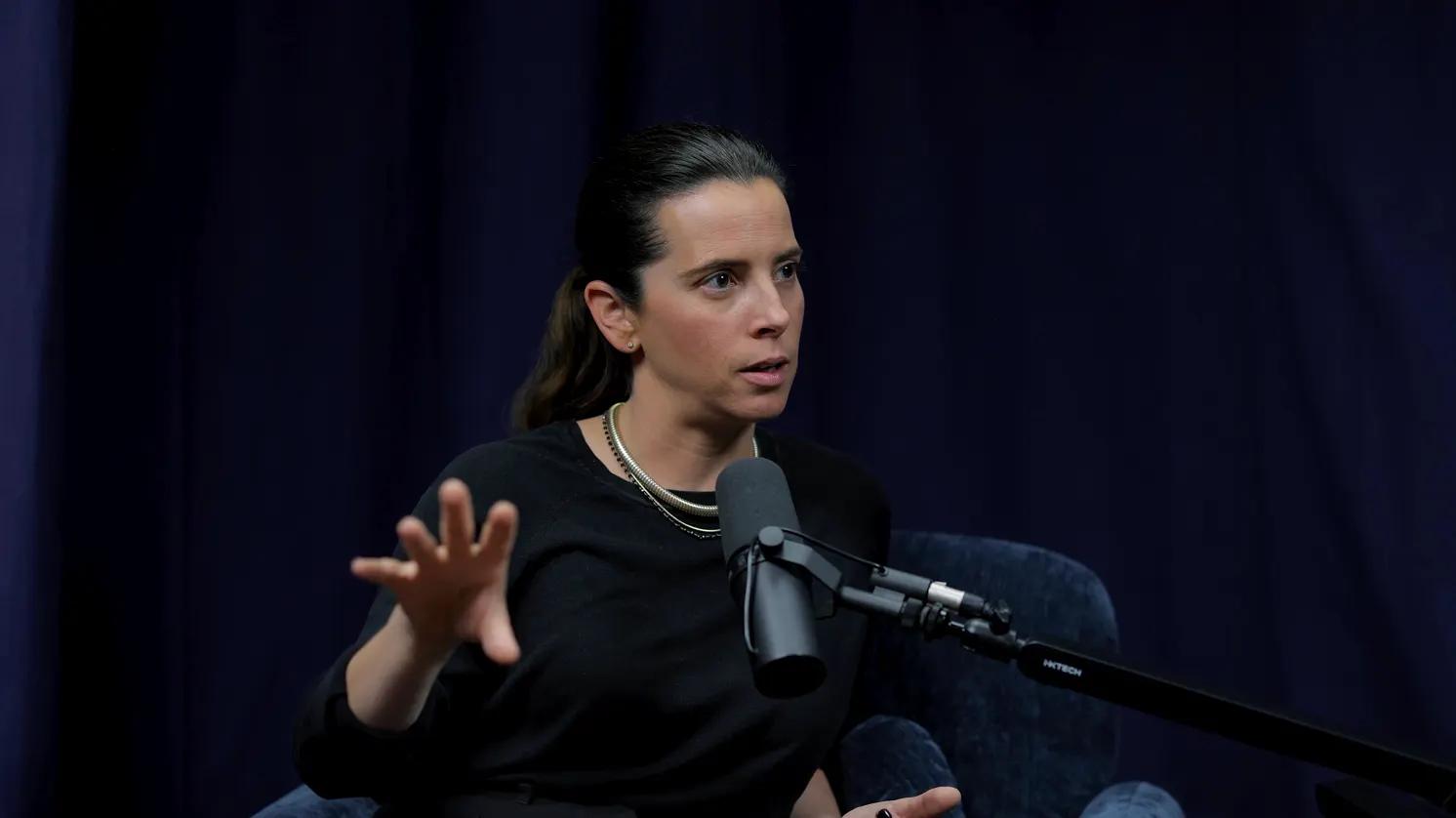
Ansón isn't a chef. She's a biologist who spent a year at Spain's National Cancer Research Centre (CNIO) and, in 2016, founded Ansón+Bonet with Miguel Bonet. Since then she has designed projects such as Gran Clavel, Media Ración and Mahou's space at the Bernabéu stadium. In an industry where everyone interviews chefs, we sat down with the person who does the maths.
We're writing against one specific idea: the restaurant as a romantic project, kept alive by passion, good produce and a couple of reviews. Talking about the old-school bars that keep disappearing, she put it bluntly: "I think I've stopped being so romantic."
Is a restaurant a profitable business in Spain?
It can be, but with thin margins and little room for error. According to Hostelería de España's 2025 Yearbook, restaurant revenue grew 3.1% up to September, driven mostly by higher prices, while profitability fell 0.9%. Restaurants are charging more and earning less.
Ansón describes the business as "very binary": it's very easy for it to go well or go badly, with no middle ground that buys you time to fix things. Her recipe for landing on the right side has nothing heroic about it. She asks you to be "restrained, aware and very cold-headed about the investment", and reminds you that hospitality is "absolutely a business of details".
The ground has shifted. In her view, making money from a restaurant today is much harder than a decade ago, because of competition, prices, overheads and wages. She doesn't say it as a complaint. She thinks it's normal that a waiter no longer works fourteen-hour days, six days a week. That model was cheap because someone paid for it with their life.
The structure of the sector doesn't help either. According to Cajamar's report on restaurants and out-of-home consumption, in 2024 there were 245,975 companies, and 73% of them were micro-businesses. Lots of self-employment, very little scale. That's why Ansón believes the market will move towards restaurant groups, as every other sector has, and she tells every founder the same thing: "What matters is understanding that restaurants are businesses." "Entrepreneur", she adds, "sounds very nice"; what's needed are business owners.
How much does it cost to open a restaurant in Madrid?
It depends on how much you do yourself. Alejandra Ansón's estimate: between €120,000 and €130,000 for a very small place where the owner does almost everything; around €300,000–400,000 with an interior designer, a branding studio and a building contractor; and €600,000–700,000 for large venues. Key money for leases, she warns, is very high.
The low figure comes with small print. She points out that this scenario means tiny places "where you have to do practically everything yourself", engineering your way to the kitchen equipment. The middle range isn't luxury: it's what it costs to open with professionals behind you.
For perspective: according to CaixaBank Research, a restaurant company in Spain had average revenue of €436,000 a year in 2022. You're putting in almost a full year of average sales before you've served your first coffee.
The useful question isn't how much, but on what. For Ansón, the first expensive mistake is investing badly: failing to tell apart what the project needs from what you fancy. Some venues live or die by an entrance in fine wood and marble with striking lighting; in others, spending a fortune on materials won't bring in a single booking.
There's one line item she ranks above almost all the others: light. Of everything you do when you set up a restaurant, she says, lighting is perhaps what has the biggest impact on the space. She isn't talking about candles; every venue needs its own, and a food counter needs white light so the product shows. And she demands consistency: you can't spend two million on interiors and then serve a cheap dish in any sense of the word. The room is a promise. The plate has to keep it.
The "gustología" mistake: opening the restaurant you'd want to eat in
"Gustología", roughly "taste-ology", is Alejandra Ansón's word for decisions made because the owner likes something, not because an audience wants it. Alongside bad investment, she sees it as the costliest mistake when opening: designing the concept as if you were the customer and assuming your friends will fill the dining room.
"The other very serious [mistake] is building concepts thinking that you're the customer, or that it's going to be full of your friends." — Alejandra Ansón
In the conversation we raised the obvious objection: clothing brands are often born from their founder's wardrobe. Her answer separates the engine from the blueprint. You have to like what you do, she says, but the decisions have to be based on a target, on a defined concept, and they have to be consistent. The example she sees most in her work is the hotchpotch menu, the one serving tacos and sushi because the owner likes both. If you're a highly creative chef at the cutting edge, it might make sense. For almost everyone else, it doesn't.
Her verdict is dry: "decisions made on gustología usually aren't the best ones". Passion starts the project. It doesn't keep it going.
What does keep it going is less glamorous. Among her ingredients for a restaurant that works, Ansón lists a concept that stays consistent over time and being a good operator, meaning delivering the same experience day after day. She explains it with a T-shirt shop: there you design once, work out the cost and sell. "In a restaurant you have to make that T-shirt every single day." And almost by hand.
Why do Michelin-starred restaurants close?
Because a star drives up costs before it drives up revenue. A study by Daniel Sands of the UCL School of Management, published in the Strategic Management Journal, tracked New York restaurants: 40% of those awarded a star between 2005 and 2014 had closed by the end of 2019. That figure is for New York, not Spain.
In the episode, the number came from the question. Ansón's answer took three words: "It's a trap." Then she adds nuance, which is what sets her apart from the easy headline. She acknowledges that Michelin has made a lot of money for a lot of people and put on the map restaurants that survive thanks to the guide, especially outside the big cities.
The problem lies in the equation. According to her, Michelin rewards a particular kind of food and service, and some owners spend heavily to fit that mould instead of thinking about their own customers. If everything clicks, it works. If one piece fails, the standard still costs the same: "That style of cooking needs a lot of people in the kitchen to serve very few diners."
Sands found something more uncomfortable: restaurants that received a star were more likely to close than comparable ones that didn't, even after accounting for location, price and type of cuisine.
Madrid adds its own twist. Ansón's theory is that in the capital a star goes unnoticed and can even count against you, because local diners don't want to go. The award that fills a dining room in a small town can empty one in Madrid.
Is €450 at DiverXO justified?
For Alejandra Ansón, yes, and her argument is about the market before the kitchen: a dining room full of people willing to pay is the only justification that counts. According to DiverXO's booking page, the tasting menu at Dabiz Muñoz's restaurant costs €450 per person, VAT included, drinks not included.
The full sentence deserves a slow read: "For me, 100%, but I don't think anything justifies a price more than people being willing to pay it and the place being full." That's a manager's answer, not a fan's. She adds another reason: Muñoz never settles, and pushes the menu forward season after season when he could have eased off.
The third reason is the one that matters to anyone not called Dabiz Muñoz. For Ansón he has been "brave", because almost every restaurant at his level would need those prices for the business to make sense. The high price isn't a chef's whim. It's the real bill for a style of cooking that takes a lot of staff to serve a few covers. Most don't dare charge it, and pay for it in losses.
And the figure keeps moving. According to The Objective, that menu cost €45 when the restaurant opened. Since February 2026 there's also an alcohol-free liquid menu, Metamorfosis, presented at Madrid Fusión at the same price as the food menu: having both costs €900 per person, as reported by Directo al Paladar.
Ferran Adrià, the Picasso of gastronomy: why influence isn't enough
The comparison is Alejandra Ansón's: in Spain, the chef most comparable to a Picasso is Ferran Adrià, because the way the world eats today has a lot to do with what he did at elBulli. His weight, she argues, lies not in the dishes he signed but in how he inspired a whole generation of cooks.
Context matters. The conversation had come from an Apple ad about people who changed the world, Picasso among them. When we asked whether anyone in Spanish cooking stood at the level Rafa Nadal holds in tennis, she said yes and chose Adrià. Nadal was the yardstick we offered; Picasso was the one she kept.
She saw it from the inside, as a child. Her father, Rafael Ansón, presided over the Real Academia de Gastronomía (Royal Academy of Gastronomy) for forty years and took her from restaurant to restaurant. She recalls going to elBulli again and again before it had the demand it later did. Her reading: Adrià stood up to a very French, almost regulated way of understanding the menu, the tableware and the plating, and cooks around the world realised they could do the same with their own ingredients.
Here's the twist that interests us. Ansón carefully separates genius from business. Of the wave of star chefs who opened casual concepts that didn't work, she sums it up: "People often confused being a good cook with being capable of running a business." Her examples on the other side are Ricard Camarena, who has built an ecosystem of projects in Valencia with his wife Mari Carmen, and the Roca brothers, who have grown without leaving Girona and without a single false step.
Genius opens the door. The business decides whether it stays open.
At the end of the episode we asked her to tell us something we didn't know. Her answer: "Being a business owner in Spain is incredibly hard, and it's heroic." Everything above is the small print of that sentence. Watch the full conversation with Alejandra Ansón on YouTube, and if you want another food story told without romance, read what Guillermo Milans told us about ten years of Baia Foods.
Frequently asked questions
Who is Alejandra Ansón?
She is a biologist by training and co-founder, with Miguel Bonet, of Ansón+Bonet, a consultancy that designs and launches hospitality projects. The company was founded in 2016, has offices in Madrid and Barcelona, and is behind venues such as Gran Clavel, Media Ración, Nunuka and Norah.
What is the minimum investment needed to open a restaurant in Madrid?
Alejandra Ansón puts the floor at around €120,000–130,000, but only for a very small venue with the owner doing almost everything. With a professional team, she talks about €300,000 to €400,000, and lease key money pushes the bill up.
Does a Michelin star guarantee a restaurant will make money?
No. It brings visibility, but it commits you to an expensive level of service and cooking. Daniel Sands's work on New York found that starred restaurants closed more often than similar ones without a star.
How much does it cost to eat at DiverXO in 2026?
The food menu costs €450 per person, according to the restaurant's website. Since February there is also the Metamorfosis liquid menu: both in full come to €900, and the combinations with half a menu cost €700, according to Directo al Paladar.
Where can I listen to the episode with Alejandra Ansón?
It's on the No me hables de tu libro YouTube channel. If it's your first time with the podcast, there's a selection of episodes to start with.